Date:2023/10/05
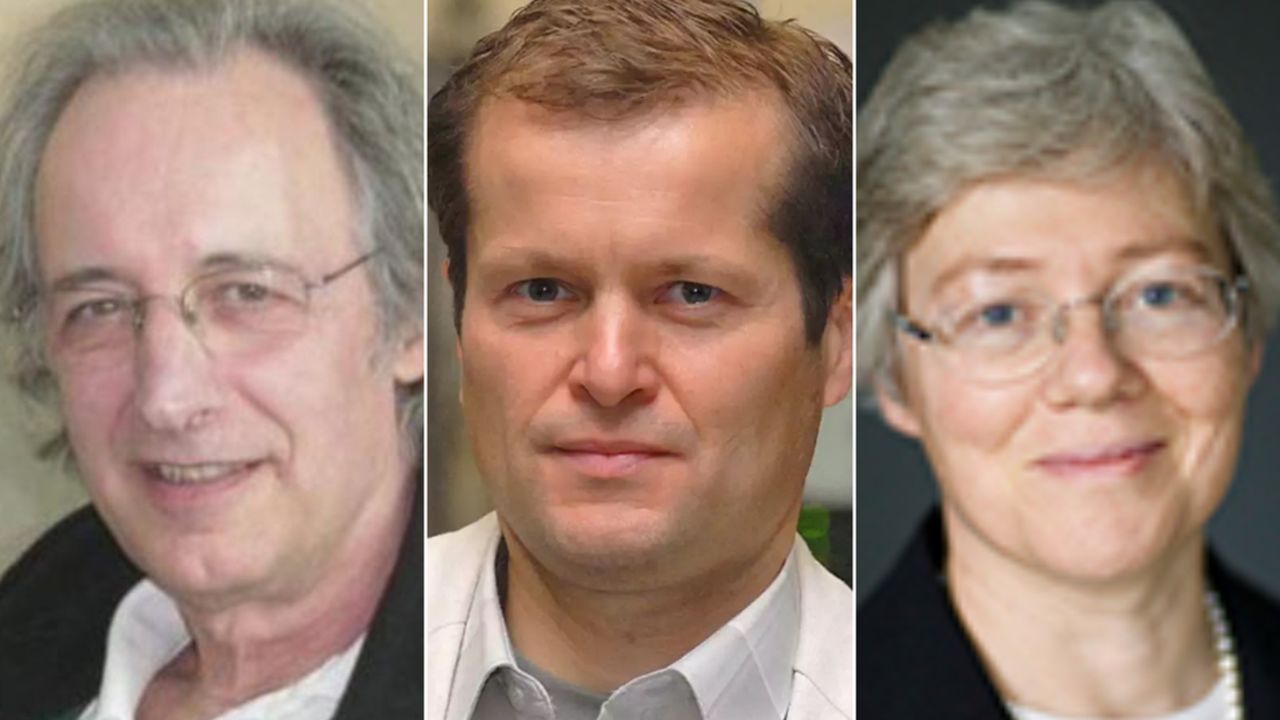
Ohio State University/Max Planck Institute of Quantum Optics/National Academy of Science
Pierre Agostini, Ferenc Krausz and Anne L'Huillier shared this year's physics prize.
Capturing a snapshot of electrons
The three winners used precision lasers to generate ultra-short bursts of light. L’Huillier, a professor at Lund University in Sweden, discovered a new effect from a laser light’s interaction with atoms in a gas. Agostini, a professor at Ohio State University, and Krausz, a professor at the Max Planck Institute of Quantum Optics in Germany, then demonstrated that this effect can be used to create shorter pulses of light than were previously possible.
“for experimental methods that generate attosecond pulses of light for the study of electron dynamics in matter”
Experiments with light capture the shortest of moments
The three Nobel Laureates in Physics 2023 are being recognised for their experiments, which have given humanity new tools for exploring the world of electrons inside atoms and molecules. Pierre Agostini, Ferenc Krausz and Anne L’Huillier have demonstrated a way to create extremely short pulses of light that can be used to measure the rapid processes in which electrons move or change energy.
Fast-moving events flow into each other when perceived by humans, just like a film that consists of still images is perceived as continual movement. If we want to investigate really brief events, we need special technology. In the world of electrons, changes occur in a few tenths of an attosecond – an attosecond is so short that there are as many in one second as there have been seconds since the birth of the universe.
The laureates’ experiments have produced pulses of light so short that they are measured in attoseconds, thus demonstrating that these pulses can be used to provide images of processes inside atoms and molecules.
In 1987, Anne L’Huillier discovered that many different overtones of light arose when she transmitted infrared laser light through a noble gas. Each overtone is a light wave with a given number of cycles for each cycle in the laser light. They are caused by the laser light interacting with atoms in the gas; it gives some electrons extra energy that is then emitted as light. Anne L’Huillier has continued to explore this phenomenon, laying the ground for subsequent breakthroughs.
In 2001, Pierre Agostini succeeded in producing and investigating a series of consecutive light pulses, in which each pulse lasted just 250 attoseconds. At the same time, Ferenc Krausz was working with another type of experiment, one that made it possible to isolate a single light pulse that lasted 650 attoseconds.
The laureates’ contributions have enabled the investigation of processes that are so rapid they were previously impossible to follow.
“We can now open the door to the world of electrons. Attosecond physics gives us the opportunity to understand mechanisms that are governed by electrons. The next step will be utilising them,” says Eva Olsson, Chair of the Nobel Committee for Physics.
There are potential applications in many different areas. In electronics, for example, it is important to understand and control how electrons behave in a material. Attosecond pulses can also be used to identify different molecules, such as in medical diagnostics.
Three scientists who study electron dynamics have jointly been awarded the Nobel Prize in Physics. One of the winners, Anne L'Huillier, is only the fifth woman to receive the award.
Ferenc Krausz was preparing to give lab tours at his Institute when a call from Stockholm reached him at home. “I was not sure whether I was dreaming, or whether it’s reality,” he tells the Nobel Prize’s Adam Smith in this call recorded just after the physics prize was announced. “It’s always exciting to see something that no-one could see before,” he says, recalling the thrilling morning in Vienna in 2001 when he first saw that they were able to reveal electron motions with their attosecond pulse technology: “This was just an unbelievable moment which I will never forget!”
Nobel Prize Conversations
“My daughter called me asking, ‘Is that true, I see it on Google?’” That was how Pierre Agostini found out he had been awarded the 2023 Nobel Prize in Physics. In this conversation with the Nobel Prize's Adam Smith, kindly facilitated by Dawn Larzelere of The Ohio State University (whose voice is heard at the start and end), Agostini talks of his surprise at receiving the prize now, his initial thoughts on hearing the news and recalls his pleasure at being the first to produce a train of attosecond light pulses back in 2001.